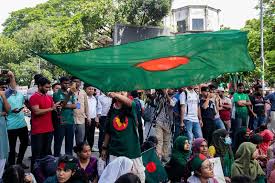
In light of the recent revolution in Bangladesh, a pertinent question arises: why are such revolutionary changes not occurring in India? Oppression and injustice are prevalent here as well. Whenever a nation experiences a revolutionary transformation, it often becomes a subject of global discussion. We believe that there are several key factors contributing to this phenomenon:
- Indians, especially Hindus, have a temperament that tends to prioritize patience and caution over fervor or revolutionary zeal. This characteristic makes them less likely to undertake drastic revolutionary actions. Consider the example of British colonial rule. In the mid-19th century, Britain stationed a far greater number of troops in Ireland compared to India, even though Ireland had a much smaller population. Approximately 35,000 soldiers and police were stationed in Ireland, where the population was 4.5 million, giving a soldier-to-civilian ratio of 1:130. In contrast, India, with a population of 300 million and located 4,000 miles away from England, had only 400,000 soldiers and policemen—resulting in a ratio of 1:750. Even so, in less than three years, a force of over 3,000 Irish guerrillas managed to destroy the colonial police and secure independence in 1921.
- Indians have a tendency to adapt to their circumstances rather than protest or resist. Instead of seeking to solve problems through direct action or protest, they often find alternative solutions. For instance, when there is a power outage, rather than demanding that the government resolve the issue permanently, people simply make do with emergency lights. A clear example of this mindset can be seen in the response to demonetization. In Western countries, such a move would likely have led to mass protests and even government overthrow, but in India, people stood patiently in long queues to exchange their currency notes.
- Over centuries, the Indian populace has come to accept oppression and hardship under the guise of religious and social traditions, which has ingrained a mindset of passivity and submission. People have grown accustomed to suffering. Iqbal, deeply pained by this reality, spent his life trying to awaken the masses. His ideas had a profound influence across the world, but in the society he was born into, his voice was often ignored, much like a cry in the wilderness.
میں نے دلوں کو ایک ولولۂ تازہ دیا,
لاہور سے تا خاکِ بخارا و سمرقند
تاثیر ہے یہ میرے نفَس کی کہ خزاں میں,
مرغانِ سحَر خواں مری صحبت میں ہیں خورسند
لیکن مجھے پیدا کیا اُس دیس میں تُو نے,
جس دیس کے بندے ہیں غلامی پہ رضا
- India is a society of immense diversity, with little in the way of shared values and a great deal of division based on language, caste, religion, region, and culture. This diversity makes it difficult to unite the masses behind a single cause. This is why the British, coming from thousands of miles away, were able to conquer India and maintain control over it for such a long time. The British capitalized on the local divisions, playing different communities against one another. As historian B.B. Mishra notes:
\”Indian troops conquered the country for the British.\”
India’s society is ancient and strongly rooted in tradition, and as a result, change tends to occur very slowly. For example, the law against sati (the practice of widow burning) was enacted in 1860, yet the last widely known case, that of Roop Kanwar, did not occur until 1987. The social structure is complex and deeply intertwined, which makes rapid revolutionary change more difficult compared to other countries.
In comparison to the West, Western societies have seen the development of professional values, which have facilitated a more rapid acceptance of change among the public. In contrast, Eastern societies, including India, tend to embrace a slower, more monastic pace of change, where transformations may take decades or even centuries. The poet-philosopher Iqbal aptly captured this distinction in his famous lines:
ضمیرِ مغرب ہے تاجرانہ، ضمیرِ مشرق ہے راہبانہ,
وہاں دِگرگُوں ہے لحظہ لحظہ، یہاں بدلتا نہیں زمانہ